Summary
Prepare for ski season with a science-backed ski conditioning plan from a Denver personal trainer. Build leg strength, eccentric control, balance, mobility, core stability, and cardio endurance with an 8-week approach designed to help you feel stronger and more controlled on the slopes.
How should you prepare your body for ski season?
Prepare for skiing with 6–8 weeks of progressive strength training, eccentric leg training, single-leg exercises, core stability, balance, and cardiovascular conditioning. Prioritize squats, split squats, step-downs, Romanian deadlifts, lateral movements, and interval cardio, and gradually increase volume so your legs can maintain control as fatigue builds on the mountain.
Topics
ski conditioning, ski conditioning workout, ski season preparation, how to prepare for ski season, how to get in shape for skiing, ski fitness training, skiing fitness, ski workout, ski training exercises, preseason ski workout, strength training for skiing, leg exercises for skiing, exercises for skiing, eccentric training for skiing, quad exercises for skiing
balance exercises for skiing, core exercises for skiing, cardio for skiing, ski endurance training, 8-week ski conditioning program, workout to prepare for skiing, Denver ski conditioning, ski fitness Denver, Denver personal trainer for skiing, personal trainer Denver, personal training LoHi Denver, Colorado ski conditioning, Colorado skiing fitness
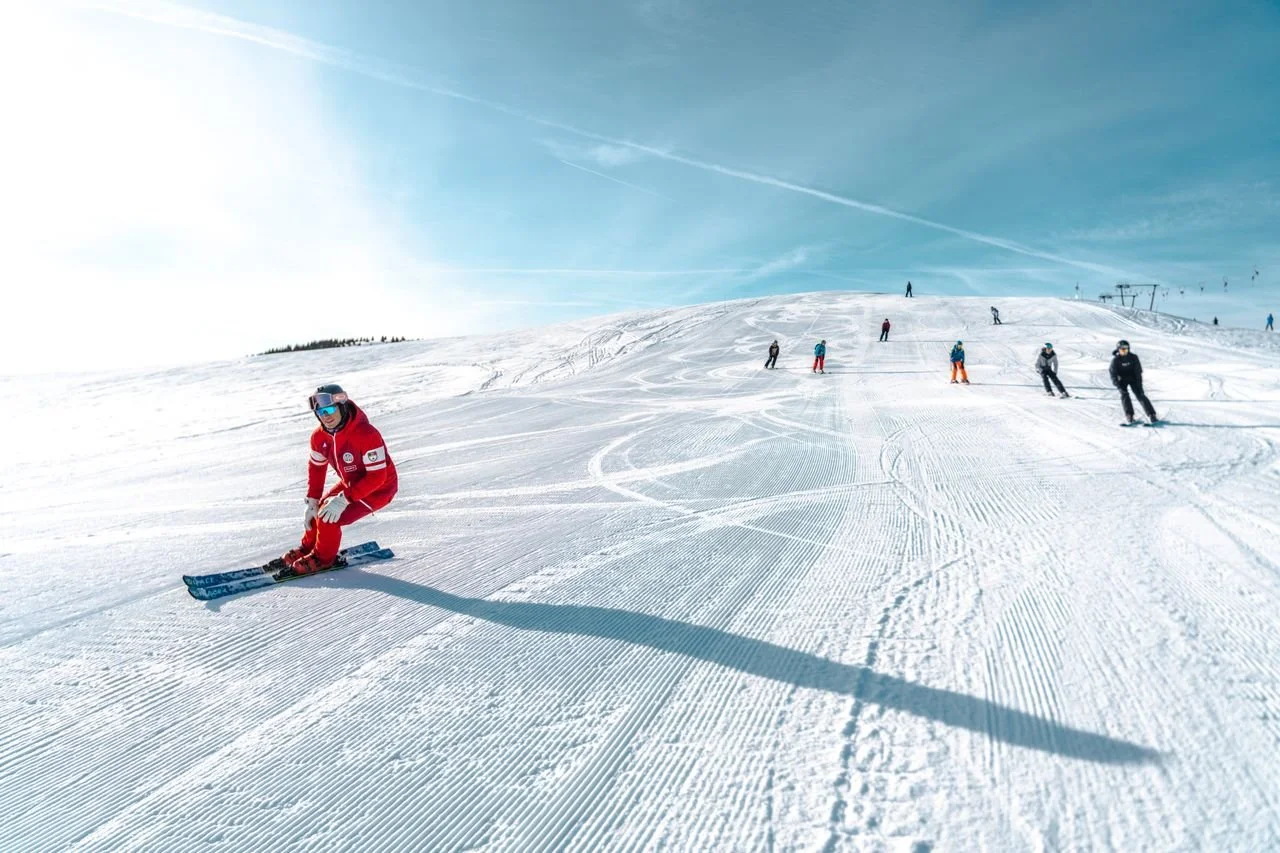
Colorado Skiing Fitness / Photo: Federico Tomasoni
Introduction
A particular kind of confidence disappears around the third long run of the first ski day. The legs begin to burn. Turns become less deliberate. You sit farther back in your boots. The short rest on the chairlift suddenly feels necessary, not leisurely. None of this means you forgot how to ski. More often, your technique is being asked to operate on top of a fitness base that’s caught up with the season.
Skiing is unusual because the mountain disguises how physically demanding it is. Gravity does much of the obvious work, but your body continuously absorbs force, controls your center of mass, resists rotation, maintains balance, and adjusts to terrain that changes beneath you. That is why the best ski-season preparation is not simply “get your legs stronger.” It is a mix of strength, muscular endurance, eccentric control, balance, aerobic conditioning, mobility, and the ability to produce competent movement after fatigue sets in.
Recent research supports that broader view. A 2025 International Ski and Snowboard Federation consensus statement recommends multifaceted preparation that addresses strength, endurance, speed, coordination, agility, mobility, and sport-specific testing, rather than relying on a single fitness quality. The recommendations were written primarily for competitive athletes, but the underlying principle applies well to recreational skiers: prepare for the sport's actual demands, not just a generic workout.
Table of Contents
How Fit Should You Be Before Ski Season?
Start Training Six to Eight Weeks Before Your First Ski Day
Build Stronger Quads Without Forgetting Your Hamstrings
Train the Brakes: Eccentric Strength Matters
Make Single-Leg Strength a Priority
Strengthen Your Hips and Lateral Movement
Train Your Core to Resist Movement
Build the Aerobic Engine Behind a Full Ski Day
Add Short Bouts of Higher-Intensity Conditioning
Train Balance Without Turning Your Workout Into a Circus
Prepare Your Ankles and Hips for Ski Position
Practice Movement While Slightly Fatigued
Use a Progressive Four-Phase Ski Conditioning Plan
What to Do During the Final Week Before Skiing
Related Articles
1. Start Training Six to Eight Weeks Before Your First Ski Day
One of the least effective ski-conditioning plans is also one of the most common: doing nothing specific until snow appears, then packing four ski days into a holiday weekend. Your connective tissue, muscles, cardiovascular system, and nervous system respond much better to progressive exposure. For a recreational skier with an existing fitness base, six to eight weeks is a practical preseason runway. Someone starting from a lower baseline may benefit from 8–12 weeks.
Don't try to recreate an entire ski day in the gym in Week 1. Begin with manageable strength and conditioning volume, then gradually add resistance, repetitions, longer sets, unilateral work, lateral movement, and cardiovascular intervals. The goal is to arrive on opening day rested, not exhausted from training. The goal is to arrive with enough reserve that skiing itself doesn't create a dramatic spike in physical demand.
2. Build Stronger Quads Without Forgetting Your Hamstrings
Skiers talk about quadriceps for good reason. The quads spend enormous time controlling knee position as you maintain a partially flexed stance and manage forces through a turn. But ski preparation should not become a month-long squat contest. A 2025 study of elite alpine skiers measured substantial quadriceps and hamstring development and strength, reinforcing the importance of considering the thigh as a coordinated system rather than training only the muscles on the front of the leg. Because the researchers studied elite competitors, their measurements shouldn’t be treated as targets for recreational skiers. The practical takeaway is simpler: strong knee extensors and flexors both matter in skiing. Build your lower-body strength sessions around exercises such as:
Goblet or front squat: 3 sets of 6–10
Romanian deadlift: 3 sets of 6–10
Split squat: 3 sets of 8 per leg
Hamstring curl: 2–3 sets of 8–12
Step-up: 2–3 sets of 8 per leg
Increase resistance gradually while keeping movement clean.
3. Train the Brakes: Eccentric Strength Matters
Skiing requires your muscles to do something gym programs often neglect: produce tension while lengthening. That is eccentric muscle action. Think about lowering slowly into a squat. Your quadriceps are working, but instead of shortening to lift you, they are controlling your descent. Skiing repeatedly asks the legs to absorb and regulate forces in similar ways. You can build this capacity without specialized equipment. Try:
Slow squat: Lower for three to four seconds, pause briefly, then stand normally.
Eccentric step-down: Stand on a box or step and take three seconds to lower one heel toward the floor.
Reverse lunge: Control the lowering phase rather than dropping into the bottom position.
Slow Romanian deadlift: Take three seconds to lower the weight while maintaining hip control.
Begin with two sets. Eccentric training can cause significant delayed soreness if introduced too aggressively.
4. Make Single-Leg Strength a Priority
Skiing may look symmetrical, but the forces experienced by the two legs are constantly changing. A useful preseason program therefore needs more than bilateral squats and leg presses. Single-leg exercises expose strength deficits, balance limitations, hip-control problems, and compensation patterns that can disappear when both feet share the workload. Good options include:
Rear-foot-elevated split squat
Step-up
Single-leg Romanian deadlift
Reverse lunge
Lateral step-down
Single-leg calf raise
Do not chase instability for its own sake. A well-controlled split squat on solid ground generally offers far more useful loading potential than trying to perform the same exercise while wobbling on an unstable surface. Strength first. Complexity later.
5. Strengthen Your Hips and Lateral Movement
Most gym routines live in a forward-and-backward world. Skiing does not. Repeated turning requires your hips and trunk to manage lateral forces while your knees and feet respond underneath you. Add frontal-plane movements once or twice each week:
Lateral lunge: 2–3 sets of 6–10 per side
Mini-band lateral walk: 2 sets of 10–15 steps
Lateral step-down: 2–3 sets of 6–8
Skater step or controlled lateral bound: 2–3 sets of 6–10 per side
Beginners should master controlled stepping patterns before advancing to faster bounds. The purpose isn’t to imitate skiing perfectly in a gym. You cannot. It is to give the hips enough capacity to control forces coming from more than one direction.
6. Train Your Core to Resist Movement
A skier's core doesn't spend the day doing sit-ups. Its more important job is to connect the upper and lower body while resisting unwanted extension, rotation, and lateral collapse. That makes these exercises particularly useful:
Pallof press
Dead bug
Side plank
Farmer carry
Suitcase carry
Cable chop or lift
Bird dog
Perform two or three core exercises during each strength session for two or three sets. If you already work with a personal trainer in Denver, this is also a good place to tailor exercise selection to previous knee, hip, shoulder, or lower-back issues rather than forcing everyone through the same ski circuit.
Quick Summary
Begin ski-specific conditioning 6–8 weeks before your first day.
Train the quadriceps and hamstrings.
Include eccentric exercises that teach your legs to absorb force.
Use single-leg exercises to expose left-to-right differences.
Strengthen the hips for lateral control.
Develop anti-rotation and anti-flexion core strength.
Maintain an aerobic conditioning base.
Add moderate amounts of higher-intensity interval work.
Train balance dynamically, not only by standing on unstable objects.
Reduce training volume during the final week before your first ski day
7. Build the Aerobic Engine Behind a Full Ski Day
Your quadriceps may complain the loudest, but cardiovascular conditioning still matters. A ski day involves repeated cycles of work and partial recovery—ski, chairlift, ski again—over several hours. A better aerobic base can make those repeated efforts less costly and improve recovery between demanding runs. Two or three weekly aerobic sessions are a reasonable preseason target for many recreational skiers. For example:
Session 1: 30–45 minutes of conversational cycling, incline walking, elliptical training, or jogging.
Session 2: 30–40 minutes at a similar moderate intensity.
Session 3: Optional longer easy session or sport-specific conditioning.
If skiing is your primary winter goal, stair climbing and incline walking can help, but they should complement, not replace, strength training.
8. Add Short Bouts of Higher-Intensity Conditioning
Skiing is not one continuous aerobic effort. Hard turns, steeper pitches, bumps, powder, and technical terrain periodically push effort much higher. Once you have built a basic conditioning foundation, add one interval session per week. A simple bike or rower workout:
Warm up 8–10 minutes.
Work hard for 45 seconds.
Recover for 75–90 seconds.
Repeat 6–8 times.
Cool down for 5–10 minutes.
The hard intervals should feel demanding but not like an all-out sprint. More is not necessarily better. Interval training improves repeat-effort capacity—not leaving your legs so depleted that you cannot complete the strength work most relevant to your ski preparation.
9. Train Balance Without Turning Your Workout Into a Circus
Balance matters in skiing, but “balance training” is sometimes reduced to standing on increasingly strange objects. Skiing presents a much more complicated problem. You must control your center of mass while moving, reacting, turning, seeing other skiers, interpreting terrain, and adjusting to changing snow. Recent clinical literature on return to alpine skiing has highlighted these perceptual, motor, and cognitive demands. Researchers argue that skiing requires movement control while simultaneously processing visual information and responding to an unpredictable environment. For a healthy recreational skier, useful progressions might include:
Single-leg balance
Single-leg reach
Step-up to balance
Single-leg Romanian deadlift
Lateral hop and controlled landing
Reaction drills using verbal direction changes
Controlled skater steps with unpredictable cues
Build competency before speed.
10. Prepare Your Ankles and Hips for Ski Position
Ski boots dramatically change ankle mechanics. Limited movement elsewhere can then show up at the knees, hips, or lower back. The 2025 FIS consensus specifically identifies hip, ankle, and lumbar-thoracic spine mobility as relevant physical qualities in competitive snow sports. A practical warm-up can include:
Knee-to-wall ankle mobilization: 8–10 repetitions
Hip-flexor stretch with glute contraction: 30 seconds per side
Adductor rock-back: 8 repetitions
90/90 hip rotation: 6–8 per side
Thoracic rotation: 6–8 per side
Mobility work should improve positions you can subsequently control. Creating a larger range of motion without strength or coordination inside that range offers limited value.
11. Practice Movement While Slightly Fatigued
Perfect movement during the first five minutes of a workout tells you relatively little about what happens during Hour 4 at the resort. Toward the latter portion of your preseason, occasionally pair controlled fatigue with movement quality. For example:
Bike moderately hard for two minutes.
Perform eight controlled step-downs per side.
Complete 20–30 seconds of lateral movement.
Perform six split squats per side.
Rest 90 seconds.
Repeat three rounds.
If mechanics deteriorate substantially, stop the set. Learning to perform sloppy repetitions while tired is not ski conditioning.
12. Use a Progressive Four-Phase Ski Conditioning Plan
Weeks 1–2: Build the Base
Strength train twice weekly. Perform two moderate aerobic sessions. Focus on squats, hinges, step-ups, core stability, ankle mobility, and fundamental single-leg control.
Weeks 3–4: Increase Strength
Progress resistance on squats, split squats, Romanian deadlifts, step-ups, and hamstring work. Add controlled eccentric step-downs and lateral lunges. Continue aerobic conditioning.
Weeks 5–6: Add Ski-Specific Endurance
Introduce longer lower-body sets, lateral movements, one interval session, and controlled fatigue circuits. Continue heavy-enough strength work so endurance does not replace force production.
Weeks 7–8: Build Capacity, Then Taper
Make sessions more ski-specific with repeated bouts of lower-body work and reaction-based movement. During the final five to seven days, reduce total training volume so you arrive at the mountain with fresh legs. Denver skiers who want an individualized plan based on injury history, skiing frequency, age, or current conditioning can use personal training in LoHi Denver to bridge the gap between a generic ski circuit and a program built around your actual movement profile.
13. What to Do During the Final Week Before Skiing
Do not cram for skiing. A punishing leg workout two days before your first mountain weekend is more likely to leave you with sore quads than with useful fitness. During the final week:
Maintain normal movement.
Reduce heavy lower-body volume.
Continue light mobility.
Keep aerobic activity easy to moderate.
Sleep consistently.
Arrive hydrated.
Avoid introducing unfamiliar exercises.
Treat the first ski day as part of your progression.
Don't start your first morning back with six consecutive expert runs just because your brain remembers last March. Give the body time to catch up.
Frequently Asked Questions
How many weeks should I train before ski season?
Six to eight weeks of specific training is a practical target for recreational skiers who already exercise regularly. Beginners, older adults, and people returning from injury may benefit from a longer 8–12-week progression.
What muscles should I strengthen for skiing?
Prioritize the quadriceps, hamstrings, gluteals, calves, hip stabilizers, and trunk. Skiing requires coordinated lower-body strength rather than development of one isolated muscle group.
Are squats good for skiing?
Yes. Squats build lower-body force capacity and tolerance in flexed-knee and hip positions. They work best as part of a broader plan that includes hinges, single-leg exercises, lateral work, and conditioning.
Are lunges good ski training?
Yes. Split squats and reverse or lateral lunges are particularly useful because they load each leg independently while challenging hip and trunk control.
Should skiers do cardio or strength training?
Both. Strength training develops the force and muscular capacity needed to control turns and absorb loads, while aerobic conditioning improves your ability to sustain repeated runs and recover throughout a long ski day.
What cardio is best for ski conditioning?
Cycling, incline walking, stair climbing, rowing, jogging, and elliptical training can all work. Choose modalities you tolerate well and combine moderate aerobic work with limited higher-intensity intervals.
Does balance training prevent ski injuries?
Balance and coordination are important components of ski preparation, but no single balance exercise can guarantee injury prevention. Skiing requires dynamic control, reaction, strength, vision, technique, equipment, and adaptation to changing terrain.
Should I train differently if I have had an ACL injury?
Yes. Previous ACL reconstruction warrants individualized medical and rehabilitation guidance. Recent ski literature emphasizes not only strength and symmetry but also reaction, visual processing, dynamic stability, and progressive return-to-snow exposure.
Peer-reviewed citations
Spörri J, Bonell Monsonís O, Balsiger P, Bahr R, Dios C, Engebretsen L, Finnoff JT, Gillespie S, Hörterer H, Mitterbauer G, Pasanen K, Raschner C, Reardon CL, Scherr J, Schobersberger W, Valtonen M, Weirather T, Gouttebarge V, Bolling C, Verhagen E. (2025). International Ski and Snowboard Federation (FIS) consensus statement on training and testing in competitive alpine and freestyle skiers and snowboarders. BMJ Open Sport & Exercise Medicine, 11, e002623.
PMID: 40919404
DOI: 10.1136/bmjsem-2025-002623
https://doi.org/10.1136/bmjsem-2025-002623
Fitze DP, Franchi MV, Müller Brusco C, Engeler N, Frey WO, Spörri J. (2025). Hamstrings and quadriceps muscle size and strength in female and male elite competitive alpine skiers. Frontiers in Physiology, 15, 1444300.
PMID: 39850451
DOI: 10.3389/fphys.2024.1444300
https://doi.org/10.3389/fphys.2024.1444300
Smith C, Grooms DR, Bradley H. (2024). Enhancing Return to Alpine Skiing: Integrating Perceptual-Motor-Cognitive Considerations in Testing and Progressions: A Clinical Commentary. International Journal of Sports Physical Therapy, 19(7), 923–934.
PMID: 38966833
DOI: 10.26603/001c.120285
ABOUT THE AUTHOR: MICHAEL MOODY, PERSONAL TRAINER
As an author, a personal trainer in Denver, and a podcast host, Michael Moody has helped personal training clients reach new fitness heights and achieve incredible weight-loss transformations since 2005. He also produces the wellness podcast "The Elements of Being" and has been featured on NBC, WGN Radio, and PBS.
Michael offers personal training to Denver residents who want to meet at the 2460 W 26th Ave studio….or in their homes throughout LoHi (80206), LoDo (80202), RiNo (80216), Washington Park (80209), Cherry Creek (80206, 80209, 80243, 80246, 80231), and Highlands (80202, 80211, 80212). Michael also offers personal training sessions in Jefferson Park (80211) and Sloan's Lake (80204, 80212).
If you’re looking for a personal trainer who can curate a sustainable (and adaptable) routine based on your needs and wants, Michael is the experienced practitioner you’ve been looking for. Try personal training for a month…your body will thank you!
Related articles
From the Michael Moody Fitness directory, these are the most relevant internal articles to place at the bottom of this post. The directory includes the existing fast-food review under weight-loss obstacles and several related nutrition, dining-out, grocery, and food-label resources.
For Denver skiers, preseason fitness is not an abstract athletic goal. Winter weekends may mean leaving LoHi before sunrise and spending the day skiing at elevations thousands of feet above Denver, often after a workweek dominated by desks, commuting, and relatively predictable gym surfaces. At Michael Moody Fitness in LoHi, ski preparation can focus on that transition: lower-body strength, eccentric control, hip and ankle mobility, balance, conditioning, and enough muscular endurance to keep moving well after several hours on the mountain. The objective is not to train like an alpine racer. The goal is to arrive at Colorado's slopes physically prepared so fitness supports your skiing instead of becoming the limiting factor.