Summer Injury Prevention in Colorado: How to Stay Strong for Hiking, Camping, Swimming, Paddleboarding, and Bouldering
Summary
Prevent summer injuries in Colorado with expert tips for hiking, camping, swimming, paddleboarding, and bouldering. Learn how to train ankles, knees, hips, shoulders, core, and grip for safer outdoor recreation near Denver.
How do you prevent summer injuries in Colorado?
Prevent summer injuries in Colorado by preparing for altitude, heat, uneven terrain, cold water, and sudden weather changes. Build ankle, hip, core, shoulder, and grip strength; progress activity gradually; use sport-specific warm-ups; pack protective gear; hydrate early; and stop when pain changes movement quality.
Topics
summer injury prevention Colorado, Colorado hiking injury prevention, Denver personal trainer injury prevention, hiking injury prevention Colorado, outdoor injury prevention Colorado
prevent hiking knee pain Colorado, paddleboarding injury prevention, swimming shoulder injury prevention, bouldering injury prevention, camping back pain prevention, ankle stability for hiking, strength training for hiking Colorado
how to prevent injuries while hiking in Colorado, best exercises for summer outdoor injury prevention, how to prepare your body for Colorado hiking, how to prevent shoulder pain from swimming, how to avoid lower back pain while camping, how to prevent finger injuries while bouldering, Denver summer outdoor fitness tips
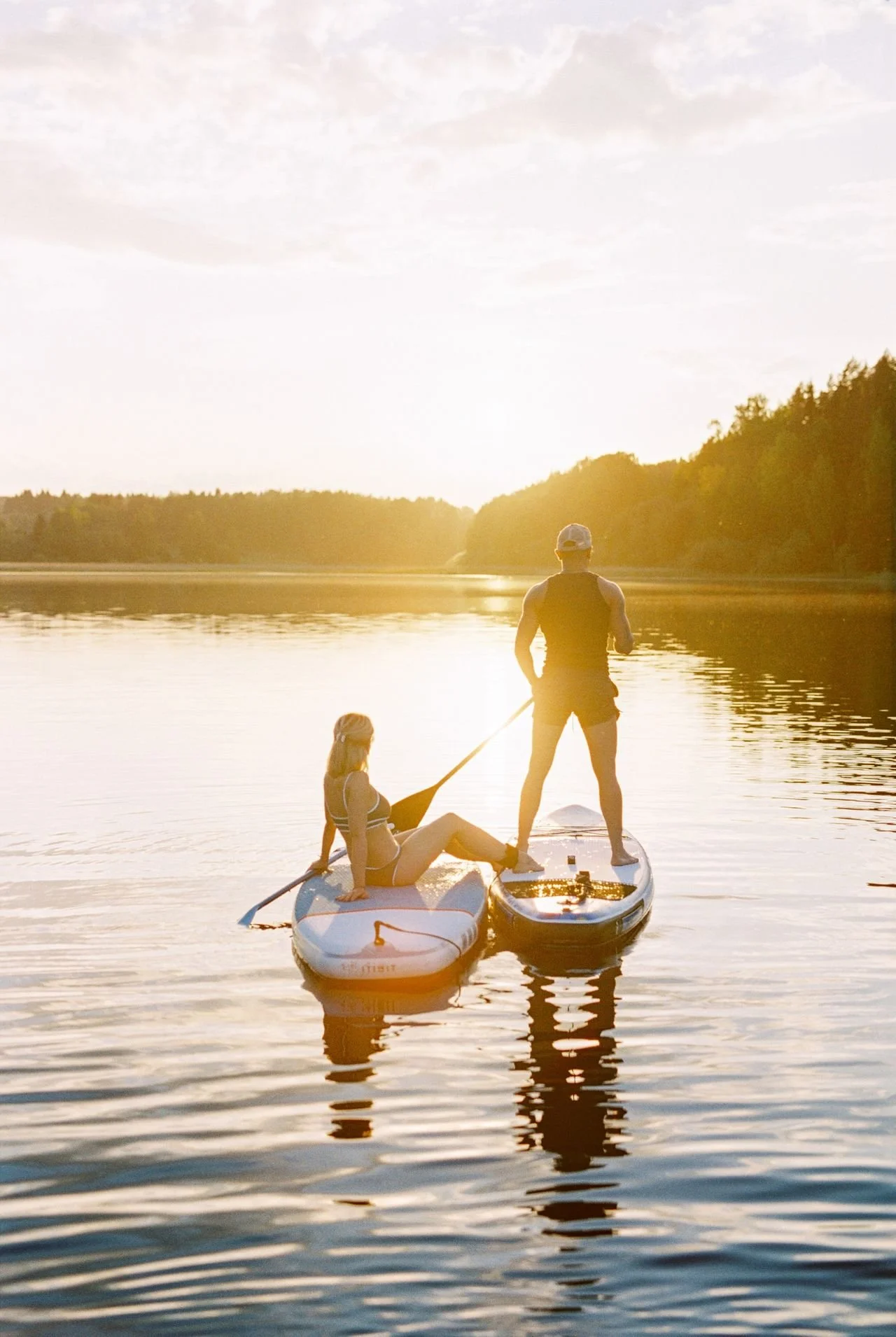
Paddleboarding Colorado / Photo: Vladimir Konoplev
Why Colorado Summer Injuries Are Different
A summer weekend in Colorado can ask more from your body than a month of ordinary gym workouts. You may start the morning in Denver, drive into thinner air, hike over loose rock, carry a cooler, sleep on the ground, swim in cold water, balance on a paddleboard, and finish the day pulling on sandstone or granite with tired fingers. None of these activities is inherently reckless. The problem is the sudden jump in load. Most summer injuries do not arrive like lightning. They accumulate. A little ankle stiffness on the first hike. A little shoulder pinch while swimming. A little lower-back tension after carrying camping gear. A little finger soreness while bouldering. By Sunday evening, the body has quietly exceeded the amount of stress it was prepared to tolerate.
Colorado adds several layers: altitude, dry air, intense sun, afternoon storms, cold alpine lakes, long approaches, steep descents, and constantly changing underfoot surfaces. Injury prevention here is not about fear. It is about respecting the difference between being “in shape” and being prepared for the exact demands of the activity. That is why a smart summer plan should include more than cardio. It should train the small stabilizers of the foot and ankle, the eccentric strength of the quadriceps for downhill hiking, the hip strength that keeps the knee from collapsing inward, the trunk endurance needed for carrying and paddling, and the shoulder control required for swimming and climbing. For readers who want individualized coaching, personal training in LoHi Denver and Denver personal training can help turn these principles into a specific plan.
Table of Contents
Why Colorado Summer Injuries Are Different
The 5-Part Summer Injury Prevention System
Hiking Injury Prevention in Colorado
Camping Without Back, Knee, and Shoulder Pain
Swimming Injury Prevention for Lakes, Pools, and Open Water
Paddleboarding: Balance, Shoulders, and Lower Back Protection
Bouldering: Fingers, Wrists, Shoulders, and Falls
A 20-Minute Colorado Summer Warm-Up
Weekly Strength Plan for Outdoor Durability
When to Stop, Modify, or Get Help
Related Articles
The 5-Part Summer Injury Prevention System
Think of injury prevention as a system, not a single stretch or gadget.
1. Capacity: Your tissues need enough strength and endurance for the task. A five-mile hike with 1,500 feet of gain is not just “walking.” It is thousands of loaded steps, many of them downhill.
2. Mobility: You need usable motion at the ankles, hips, thoracic spine, and shoulders. If one area does not move well, another area often compensates.
3. Control: Strength is only useful if you can organize it. Balance, deceleration, landing mechanics, scapular control, and core stiffness matter outdoors.
4. Progression: The body adapts beautifully when load increases gradually. It protests when a person jumps from desk work to an all-day scramble.
5. Recovery: Sleep, food, hydration, and rest days are not soft variables. They determine whether tissue adapts or becomes irritated.
Use those five filters before every major summer outing: Do I have the capacity? Do I move well enough? Can I control the positions? Did I progress into this? Have I recovered from the last effort?
Hiking Injury Prevention in Colorado
Hiking injuries in Colorado often cluster around the ankle, knee, hip, lower back, and foot. The uphill section exposes your aerobic capacity and calf endurance. The downhill section exposes your quadriceps, knee control, ankle stability, and patience. The descent is usually where people get sloppy. Fatigue shortens the stride. Toes jam into the front of the shoe. Knees drift inward. The trunk leans back. Trekking poles come out too late. A preventable ache becomes a predictable injury. Before summer hiking season, build three qualities.
First, train downhill legs. Step-downs, split squats, reverse lunges, and slow eccentric squats help the quadriceps absorb force. Use a three-second lowering phase. If your knee wobbles or your arch collapses, reduce the height or load.
Second, train ankles on purpose. Single-leg balance, calf raises, tibialis raises, and lateral step-downs prepare the lower leg for rocks, roots, and angled trail surfaces. Do not wait until the trail to discover that your ankles only know flat sidewalks.
Third, train loaded walking. A backpack changes posture, stride, and breathing. Practice with 10–20 pounds before expecting your body to tolerate a full day of snacks, water, layers, and emergency gear.
A practical progression: begin with a two- to three-mile easy trail, then add either distance or elevation each week, not both aggressively. If you hike hard on Saturday, make Sunday a recovery walk or mobility session rather than another maximal effort. On the trail, shorten your stride on descents, keep your chest stacked over your ribs, and use trekking poles before fatigue becomes obvious. Poles are not a sign of weakness. They are a load-management tool.
Camping Without Back, Knee, and Shoulder Pain
Camping injuries are rarely dramatic but common. The awkward lift is the classic culprit: cooler from trunk to ground, tent bag from garage shelf to car, water jug from picnic table to campsite, sleeping child from camp chair to tent. The fix is not complicated. Treat camping gear like gym equipment. Hinge at the hips. Brace before lifting. Keep the object close. Split heavy loads into shorter trips. Rotate your whole body instead of twisting your spine while holding a cooler.
Sleep setup is important too. If your back hates the ground, do not romanticize suffering. Use an appropriate sleeping pad, place a small towel under the knees if lying on your back, and bring a pillow that keeps the neck neutral. For side sleepers, a pillow between the knees can reduce hip and lower-back irritation.
Knees often complain during camping because people spend long periods squatting, kneeling, or stepping in and out of low tents. Use a kneeling pad, alternate positions, and stand up before stiffness becomes pain. Shoulders can flare from repetitive overhead setup tasks, especially when hammering stakes, hanging tarps, or lifting gear onto roof racks. Share the work and switch sides.
A five-minute campsite reset at night can help: calf stretch, hip flexor stretch, thoracic rotation, glute bridge, and dead bug breathing. It is not glamorous. It works.
Swimming Injury Prevention for Lakes, Pools, and Open Water
Swimming feels gentle because it is non-impact, but the shoulder may disagree. Repetitive overhead motion can irritate the rotator cuff, biceps tendon, and structures around the shoulder blade, especially when a person suddenly increases yardage in summer. The most important rule: do not use swimming as a punishment workout. If you have not trained in the water consistently, start with shorter intervals and generous rest. Technique fatigue changes everything. Once the elbow drops, the head lifts, and the shoulder rolls forward, every stroke becomes more expensive.
Before swimming, warm up the shoulder blade and rotator cuff: band pull-aparts, wall slides, light external rotations, and scapular push-ups. In the water, vary strokes when appropriate, breathe bilaterally if you can, and stop if shoulder pain sharpens or changes your mechanics. Open-water swimming in Colorado deserves extra caution. Cold water can change breathing quickly. Lakes can be windy, crowded, and disorienting. Swim with another person, use a bright cap or buoy, know the exit point, and do not combine alcohol with water recreation. Diving into unknown water is never worth the risk.
Paddleboarding: Balance, Shoulders, and Lower Back Protection
Stand-up paddleboarding looks relaxed until the wind changes. Then the body suddenly needs foot strength, hip control, trunk rotation, shoulder endurance, and calm decision-making. Most paddleboarding aches come from three places: gripping too hard, paddling only with the arms, and standing rigidly. A better position is athletic but relaxed: soft knees, feet rooted, ribs stacked over pelvis, eyes on the horizon, and paddle strokes initiated from the trunk rather than the shoulder alone.
Before you paddle, practice three land-based drills: single-leg balance, hip hinge, and half-kneeling cable or band rows. These teach the body to stabilize while the upper body moves. If your lower back tightens while paddling, shorten the stroke, rotate through the rib cage, and avoid excessive reaching. Use a leash and a properly fitted personal flotation device. Check wind direction before launching. A calm lake at 9 a.m. can become a very different body of water by early afternoon. Beginners should kneel when conditions change rather than fighting the board from a tall, unstable position.
Quick Summary
Build downhill leg strength before long Colorado hikes.
Train ankles and hips for uneven trails, not just flat gym floors.
Practice loaded carries before camping trips.
Warm up shoulders before swimming, paddleboarding, and bouldering.
Increase distance, elevation, and intensity gradually.
Use trekking poles, helmets, pads, leashes, and flotation devices when appropriate.
Respect altitude, sun, wind, cold water, and afternoon weather shifts.
Stop when pain changes movement quality.
Strength train twice per week to support outdoor recreation.
Treat recovery as part of the injury-prevention plan.
Bouldering: Fingers, Wrists, Shoulders, and Falls
Bouldering compresses a large amount of force into small structures. Fingers, pulleys, wrists, elbows, shoulders, and ankles all take turns absorbing load. The risk rises when enthusiasm exceeds tissue readiness. The first injury-prevention rule is simple: warm up longer than you want to. Begin with general movement, then easy traversing, then progressively harder holds. Avoid jumping straight to tiny crimps or dynamic moves. Fingers adapt more slowly than lungs and legs.
Use open-hand grips when possible, limit aggressive crimping, and stop if you feel a sudden pop, sharp finger pain, or loss of grip strength. Shoulders need the same respect. Scapular pull-ups, external rotation work, rows, and controlled hangs can help prepare the shoulder complex, but volume must be earned. Falls deserve equal attention. Practice downclimbing. Learn how to land: knees soft, arms in, roll if needed, and avoid reaching backward with a straight arm. Many bouldering injuries occur not on the wall but when a tired climber casually drops from a height they have stopped respecting.
Outdoor bouldering adds uneven landings, heat, skin wear, and route-finding stress. Use pads, spotters, and conservative judgment. The problem of being “one grade below your limit” indoors may not be the same as outside after a long hike in the sun.
A 20-Minute Colorado Summer Warm-Up
Use this before hiking, paddleboarding, climbing, or a mixed outdoor day.
Minutes 1–3: Breathing and posture
Stand tall, inhale through the nose, exhale slowly, and stack ribs over pelvis. Add gentle arm swings and trunk rotations.Minutes 4–6: Ankles and calves
Perform 10 calf raises, 10 tibialis raises, and 10 ankle circles each direction.Minutes 7–9: Hips
Perform 8 reverse lunges per side, 10 glute bridges, and 8 lateral lunges per side.Minutes 10–12: Core
Perform dead bugs, bird dogs, or a short plank. Prioritize control over intensity.Minutes 13–15: Shoulders
Perform band pull-aparts, wall slides, and light external rotations.Minutes 16–18: Balance and deceleration
Perform single-leg balance, step-downs, or slow squat-to-stands.Minutes 19–20: Activity rehearsal
Mimic the day: short uphill walk, easy paddle strokes, easy climbing movement, or a few controlled carries.
Weekly Strength Plan for Outdoor Durability
A two-day plan is enough for many adults during summer, especially when weekends are active.
Day 1: Lower Body and Core
Step-ups: 3 sets of 8 per side
Romanian deadlift: 3 sets of 8
Split squat: 2–3 sets of 8 per side
Calf raise: 3 sets of 12
Side plank: 2 sets of 20–40 seconds per side
Farmer carry: 3 rounds of 30–60 seconds
Day 2: Upper Body, Hips, and Rotation
Row: 3 sets of 10
Push-up or incline push-up: 3 sets of 6–12
Band external rotation: 2–3 sets of 12
Lateral lunge: 3 sets of 8 per side
Pallof press: 2–3 sets of 10 per side
Suitcase carry: 3 rounds of 30–60 seconds per side
The goal is not exhaustion. It is readiness. Leave a little in the tank so your weekend activity improves rather than becomes a survival test.
When to Stop, Modify, or Get Help
A small ache is not always an emergency, but certain signals deserve respect. Stop or modify if pain changes your gait, causes limping, sharpens with each repetition, produces swelling, creates numbness or tingling, or persists beyond 48–72 hours without improvement. For swimming and paddleboarding, stop if shoulder pain alters your stroke or makes overhead reach feel unstable. For bouldering, stop immediately if you experience sudden finger pain, a pop, visible swelling, or grip weakness. For hiking, do not “walk off” a worsening ankle sprain miles from the trailhead unless the risk of evacuation forces you to move carefully. The earlier you adjust, the easier the fix usually is. Summer is long. One conservative decision in June can save July and August.
Frequently Asked Questions (FAQ)
What are the most common summer outdoor injuries in Colorado?
Common problems include ankle sprains, knee pain, lower-back irritation, shoulder pain, finger strains, cuts, falls, heat illness, dehydration, and water-related injuries. Risk rises when people rapidly increase distance, elevation, load, intensity, or technical difficulty.How do I prevent knee pain while hiking downhill?
Train eccentric leg strength with step-downs, split squats, slow squats, and controlled lunges. On the trail, shorten your stride, use trekking poles, avoid leaning backward, and reduce distance or elevation if pain changes your gait.What exercises help prevent ankle sprains on Colorado trails?
Single-leg balance, calf raises, tibialis raises, lateral step-downs, and loaded carries improve lower-leg strength and control. Practice on safe uneven surfaces before committing to technical hikes.How can I prevent shoulder pain from swimming?
Increase swim volume gradually, warm up with rotator cuff and scapular exercises, maintain technique, and stop if shoulder pain changes your stroke. Sudden increases in summer yardage are a common trigger.Is paddleboarding hard on the lower back?
It can be if you paddle only with your arms, stand rigidly, or overreach. Use soft knees, trunk rotation, relaxed grip, and shorter strokes. Land-based hip hinge, balance, and core work can reduce irritation.How do I avoid finger injuries while bouldering?
Warm up progressively, avoid hard crimping early, limit sudden jumps in difficulty, and stop if you feel sharp finger pain, a pop, swelling, or grip weakness. Fingers adapt more slowly than enthusiasm.How many days per week should I strength train for summer outdoor activities?
Two well-designed sessions per week can be enough for many recreational adults. Focus on legs, hips, ankles, core, shoulders, carries, and progressive loading rather than random fatigue.
Peer-Reviewed Citations
Bigdon SF, Hecht V, Fairhurst PG, Deml MC, Exadaktylos AK, Albers CE. 2022. Injuries in alpine summer sports - types, frequency and prevention: a systematic review. BMC Sports Science, Medicine and Rehabilitation.
PMID: 35501847
DOI: 10.1186/s13102-022-00468-4
Stephenson SD, Kocan JW, Vinod AV, Kluczynski MA, Bisson LJ. 2021. A Comprehensive Summary of Systematic Reviews on Sports Injury Prevention Strategies. Orthopedic Journal of Sports Medicine.
PMID: 34734094
DOI: 10.1177/23259671211035776
Hill L, Mountjoy M, Miller J. 2022. Non-shoulder Injuries in Swimming: A Systematic Review. Clinical Journal of Sport Medicine.
PMID: 33852442
DOI: 10.1097/JSM.0000000000000903
ABOUT THE AUTHOR: MICHAEL MOODY, PERSONAL TRAINER
As an author, a personal trainer in Denver, and a podcast host, Michael Moody has helped personal training clients reach new fitness heights and achieve incredible weight-loss transformations since 2005. He also produces the wellness podcast "The Elements of Being" and has been featured on NBC, WGN Radio, and PBS.
Michael offers personal training to Denver residents who want to meet at the 2460 W 26th Ave studio….or in their homes throughout LoHi (80206), LoDo (80202), RiNo (80216), Washington Park (80209), Cherry Creek (80206, 80209, 80243, 80246, 80231), and Highlands (80202, 80211, 80212). Michael also offers personal training sessions in Jefferson Park (80211) and Sloan's Lake (80204, 80212).
If you’re looking for a personal trainer who can curate a sustainable (and adaptable) routine based on your needs and wants, Michael is the experienced practitioner you’ve been looking for. Try personal training for a month…your body will thank you!
Related articles
From the Michael Moody Fitness directory, these are the most relevant internal articles to place at the bottom of this post. The directory includes the existing fast-food review under weight-loss obstacles and several related nutrition, dining-out, grocery, and food-label resources.
Injury Prevention: Lower Limb Program for Shin Splints, Tight Calves, and Weak Ankles
Optimizing Thoracic Spine Mobility to Limit Neck and Shoulder Discomfort
Quandary Peak Trail: A Complete Guide to Hiking This Iconic Colorado 14er
How Denver’s Altitude Changes Your Workout: Heart Rate, Breathing, and Smarter Progression
The 7 Most Common Gym Injuries and How to Prevent Them With Smart Programming
Denver summers reward the prepared. From a LoHi starting point, you can reach foothill trails, paddleboarding spots, climbing gyms, mountain lakes, and high-country trailheads in the same week, but that access also tempts people into doing too much too soon. Michael Moody Fitness trains Denver adults for the real demands of Colorado recreation: stronger downhill legs, steadier ankles, more resilient shoulders, better core control, and smarter progression from weekday workouts to weekend adventure.