Senior Fitness Personal Trainer Denver: Strength, Balance, and Independence After 60
Summary
Build strength, balance, mobility, and confidence after 60 with senior fitness personal training in Denver. Learn safe exercises, weekly training structure, fall-prevention strategies, and when to work with a personal trainer in LoHi.
What is the best fitness plan for adults over 60?
The best fitness plan for adults over 60 combines progressive strength training, balance work, joint-friendly mobility, moderate cardio, and recovery days. A safe program should begin with an assessment, progress gradually, and focus on daily-life skills such as standing, climbing stairs, carrying groceries, walking confidently, and getting up from the floor.
Topics
senior fitness personal trainer Denver; senior personal trainer Denver; personal trainer for seniors Denver; senior fitness Denver; older adult fitness trainer Denver; personal training for seniors Denver; Denver senior strength training; LoHi senior personal trainer; private personal training for seniors Denver
strength training after 60; balance exercises for seniors; fall prevention exercises for seniors; senior mobility training; functional fitness for seniors; exercises for older adults; personal trainer for adults over 60; safe strength training for seniors; senior fitness assessment; power training for older adults
how to build strength after 60; best workout plan for seniors; how seniors can improve balance; exercise plan for independence after 60; Denver personal trainer for osteoporosis; personal trainer for seniors with arthritis
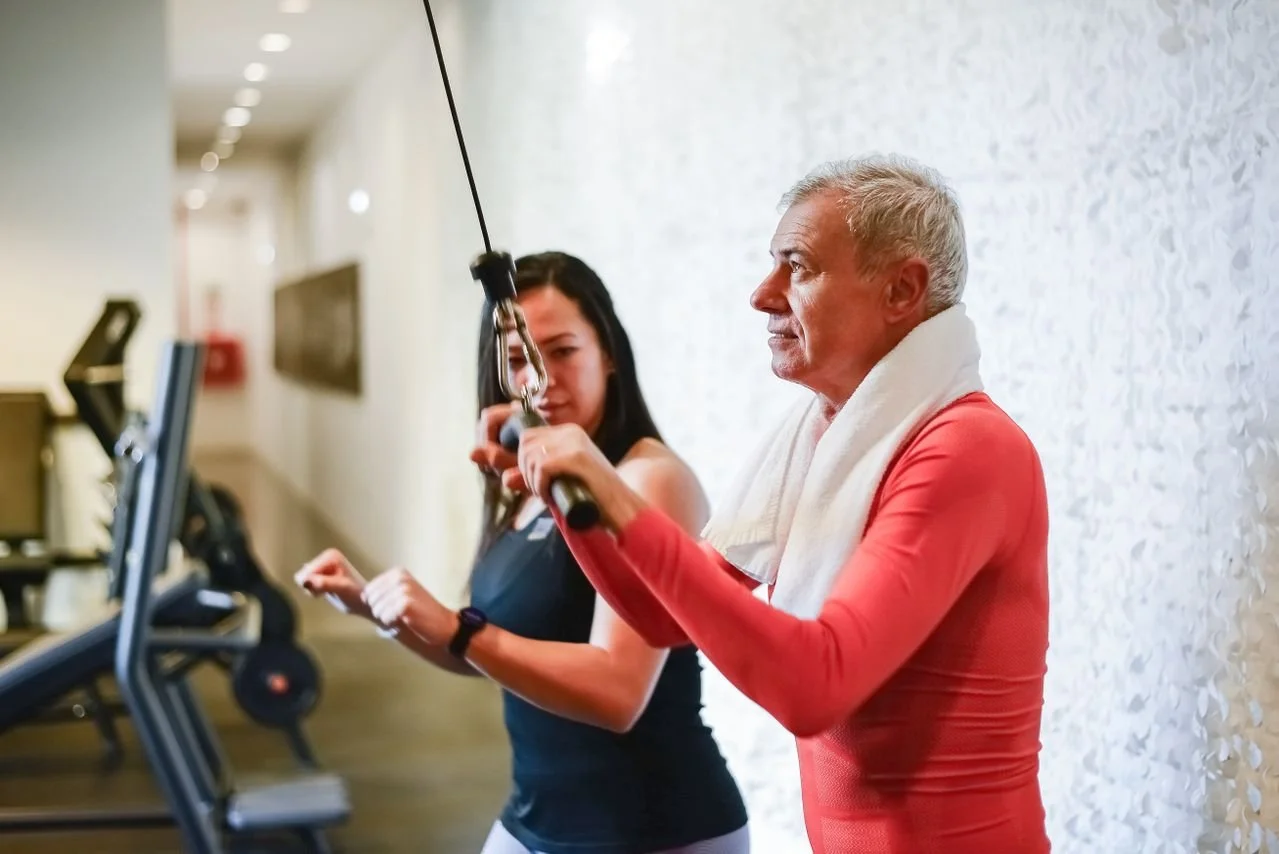
Senior Fitness Denver / Photo: Kampus Production
Table of Contents
Why Fitness After 60 Needs a Different Standard
The Real Goal: Independence, Not Exhaustion
Start With an Assessment, Not a Workout
The Five Abilities Every Senior Fitness Plan Should Train
Strength Training: The Foundation for Daily Life
Balance Training: More Than Standing on One Foot
Power Training: The Missing Ingredient for Aging Well
Mobility and Joint-Friendly Movement
Cardio for Energy, Heart Health, and Colorado Living
Recovery, Soreness, and Progression After 60
A Sample Week of Senior Fitness Training
When to Work With a Personal Trainer
Related Articles
Why Fitness After 60 Needs a Different Standard
A good senior fitness program should not feel like a watered-down version of a 30-year-old’s gym plan. It should be more exact, not less. The exercises should have a reason. The warm-up should prepare joints, feet, hips, spine, shoulders, and breathing for the work ahead. The strength training should support real tasks: rising from a chair, stepping off a curb, lifting a suitcase, carrying groceries, gardening, hiking, playing with grandchildren, or navigating an icy Denver sidewalk without panic.
Many adults in their 60s, 70s, and 80s do not need a cheerleader shouting through random circuits. They need a clear map. They need a plan that respects previous injuries, medications, joint replacements, arthritis, osteopenia, osteoporosis, back discomfort, balance concerns, and the normal fear that can appear after a fall or a long period away from exercise. A well-designed program does not chase soreness. It builds capability.
If you are comparing options, start with these three resources: personal training in LoHi, senior fitness personal training in Denver, and personal training in Denver.
The Real Goal: Independence, Not Exhaustion
The best senior fitness plan answers one practical question: What do you want your body to keep doing for the next decade? That answer may include travel, golf, pickleball, hiking, gardening, home projects, walking the dog, volunteering, or simply moving through the day without feeling fragile. These goals are not small. They are the physical architecture of independence. A useful personal training program should improve:
Lower-body strength for stairs, chairs, hills, and balance recovery
Upper-body strength for carrying, lifting, pushing, and pulling
Hip and ankle control for walking confidence
Trunk stability for spinal support and safe rotation
Grip strength for real-world carrying and fall protection
Walking endurance for energy and cardiovascular health
Power for quick reactions, not just slow strength
Mobility for joints that need movement but not punishment
Aging does not remove the need for training. It changes the cost of guessing.
Start With an Assessment, Not a Workout
The first session should not be a random tour through machines. It should be an investigation. A practical senior fitness assessment may include:
Health and injury history
A personal trainer should ask about joint replacements, osteoporosis or osteopenia, arthritis, spinal history, balance issues, falls, medications, blood pressure, dizziness, neuropathy, pain patterns, and physician or physical therapy recommendations.Sit-to-stand ability
Can you stand from a chair without using your hands? Do your knees collapse inward? Do you shift to one side? Do you lose balance at the top?Walking and gait observation
A careful eye can notice shortened stride length, foot drag, limited hip extension, poor arm swing, asymmetry, or hesitation when turning.Balance confidence
Standing balance is useful, but real balance includes stepping, turning, reaching, carrying, and recovering from small mistakes.Shoulder, spine, hip, and ankle mobility
Many older adults do not need extreme flexibility. They need enough usable motion to move well without compensating.Training tolerance
A smart program considers how your body responds 24–48 hours later. The workout is only successful if you recover from it.
The assessment should lead to the program. Otherwise, the personal trainer is guessing.
The Five Abilities Every Senior Fitness Plan Should Train
A complete senior fitness program should train five overlapping abilities: strength, balance, power, mobility, and endurance.
1. Strength
Strength is the base. Without it, daily tasks feel harder than they should. The goal is not bodybuilding. The goal is usable force.
Examples:
Sit-to-stand
Step-ups
Supported squats
Cable rows
Incline push-ups
Glute bridges
Farmer carries
Hip hinges
Band pull-aparts
Seated or standing presses
2. Balance
Balance training should be progressive. Holding a single-leg stance near a wall is only one layer. Better programming gradually adds head turns, reaching, stepping, turning, carrying, and changes in surface or direction.
Examples:
Tandem stance
Staggered stance reaches
Lateral stepping
Step-and-hold drills
Supported single-leg balance
Farmer carry walks
Controlled turning drills
3. Power
Power is the ability to produce force quickly. It helps you catch yourself when you trip, rise from a chair with confidence, step over an obstacle, or react to a dog pulling the leash. For older adults, power training should be low-impact, precise, and carefully coached.
Examples:
Fast-but-controlled sit-to-stand
Medicine ball chest pass to wall
Light cable punch
Step-up with intentional drive
Quick heel raise
Low-impact marching intervals
4. Mobility
Mobility keeps movement options available. The point is not to stretch endlessly. The point is to restore enough motion so strength can be expressed safely. Examples:
Ankle rocks
Hip flexor mobility
Open-book thoracic rotation
Wall slides
Calf mobility
Gentle hamstring flossing
Shoulder blade control drills
5. Endurance
Cardio should support life, not drain it. Walking, cycling, swimming, hiking, rowing, or low-impact intervals can all work depending on the person. In Denver, where daily life may include hills, altitude, stairs, and outdoor recreation, aerobic capacity has a practical value.
Strength Training: The Foundation for Daily Life
Strength training deserves the first chair at the table. Many adults think balance is the main problem, and sometimes it is. But balance often improves when the legs, hips, feet, and trunk become stronger. A senior fitness strength plan should usually begin with controlled, low-risk patterns:
Squat pattern: sit-to-stand, box squat, supported squat
Hinge pattern: hip hinge, glute bridge, Romanian deadlift variation
Push pattern: wall push-up, incline push-up, chest press
Pull pattern: cable row, band row, supported dumbbell row
Carry pattern: farmer carry, suitcase carry, front carry
Core pattern: dead bug, Pallof press, bird dog, loaded carry
The key is progression. You do not need to lift heavy on day one. You need to learn the pattern, build control, and gradually increase challenge. A practical starting prescription might look like this:
2–3 strength sessions per week
5–7 major exercises per session
1–3 sets per exercise
6–12 repetitions for strength movements
Moderate effort, leaving 2–4 repetitions “in reserve”
Longer rest when balance, breathing, or technique declines
Good training does not bury you. It gives you a little more body than you had last week.
Quick Summary:
Senior fitness should train independence, not exhaustion.
Strength training supports stairs, chairs, balance, posture, and daily tasks.
Balance training should include stepping, turning, reaching, and carrying.
Power matters because real life requires quick reactions.
Mobility should be specific to ankles, hips, spine, shoulders, and gait.
Cardio should improve energy and walking confidence without punishing the joints.
Recovery is part of the program, not a sign of weakness.
A personal trainer should assess before prescribing.
The best plan is progressive, measurable, joint-aware, and realistic.
In Denver, training should prepare you for hills, stairs, altitude, sidewalks, trails, and an active Colorado lifestyle.
Balance Training: More Than Standing on One Foot
Balance is not a parlor trick. It is an interaction between vision, inner ear function, foot sensation, ankle mobility, hip strength, reaction time, attention, and confidence. That means balance training should be layered.
Level 1: Static balance
Stand with feet hip-width, narrow, staggered, tandem, or single-leg with support nearby.Level 2: Weight shifting
Shift forward and back, side to side, and diagonally without gripping the floor with your toes.Level 3: Stepping balance
Practice stepping forward, backward, and sideways. The step should be quiet, deliberate, and controlled.Level 4: Turning and reaching
Most falls do not happen while standing perfectly still. They happen during transitions: turning, reaching, carrying, walking while distracted, or changing direction.Level 5: Loaded balance
Carrying a weight while walking trains posture, grip, trunk control, and balance under real-life conditions.
A personal trainer should choose the level that challenges you without frightening you. Confidence matters. Fear changes movement.
Power Training: The Missing Ingredient for Aging Well
Many senior fitness programs include strength and stretching but ignore power. That is a mistake. Power declines with age, and it matters because life is not always slow. You may need to catch your balance quickly, step over a crack in the sidewalk, get out of a low chair, or react when the dog suddenly lunges toward a squirrel. Power training does not mean jumping onto boxes or doing risky boot-camp drills. It can be quiet and controlled. Examples:
Fast sit-to-stand: Stand up with intent, then sit down slowly.
Light medicine ball press: Press or toss a light ball to a wall from a stable stance.
Quick step and hold: Step forward or sideways, then freeze with control.
Cable press with speed: Press a light cable smoothly but with purpose.
Marching intervals: Lift the knees rhythmically while maintaining a tall posture.
The rule: move quickly only when you can move cleanly.
Mobility and Joint-Friendly Movement
Older adults are often told to stretch more. Sometimes that helps. Sometimes the problem is not flexibility; it is weakness, poor control, fear, or a joint that needs a different strategy. A good mobility plan is specific.
For stiff ankles: calf mobility, ankle rocks, step-down control
For tight hips: hip flexor mobility, glute bridges, supported split-stance work
For rounded posture: thoracic extension, cable rows, wall slides, breathing drills
For shoulder discomfort: scapular control, light rows, landmine or incline pressing, range-limited movement
For lower-back sensitivity: hip hinge practice, dead bug variations, carries, anti-rotation core work
Joint-friendly training does not mean avoiding effort. It means choosing the right tool.
Cardio for Energy, Heart Health, and Colorado Living
Cardio after 60 should not be treated like punishment for eating. It should be a way to expand your life. For many older adults, walking is the easiest starting point. The progression can be simple:
Week 1–2: 10–20 minutes at a comfortable pace
Week 3–4: Add small hills or slightly longer walks
Week 5–6: Add one day with short intervals, such as 30 seconds brisk and 90 seconds easy
Week 7 and beyond: Build toward 120–180 minutes per week, depending on tolerance, goals, and medical history
Cycling, swimming, elliptical training, and rowing can also work well. The best cardio plan is the one your joints accept, and your schedule can sustain. Denver adds a local wrinkle: altitude and terrain. A flat walk in a climate-controlled gym is not the same as a neighborhood walk with uneven sidewalks, stairs, heat, cold, or hills. Your training should prepare you for the world you actually live in.
Recovery, Soreness, and Progression After 60
Soreness is not the scorecard. In fact, excessive soreness can be a sign that the program jumped too far too quickly. A better progression model uses these questions:
Did you feel safe during the session?
Did your joints feel better, the same, or worse afterward?
Were you able to sleep normally that night?
Did soreness fade within 24–48 hours?
Did your energy improve over the week?
Did your walking, stairs, or daily tasks feel easier?
Progress may look like adding five pounds to a cable row. It may also look like standing from a chair without pushing off, walking farther without stopping, carrying groceries without shoulder pain, or feeling steady on a curb. The body keeps receipts. Small, consistent deposits matter.
A Sample Week of Senior Fitness Training
This sample is not medical advice or a substitute for an individualized program, but it illustrates what a balanced week might look like.
Monday: Strength and Balance
Warm-up: 5–8 minutes easy walking or cycling
Ankle rocks: 1–2 sets of 8 per side
Sit-to-stand: 2–3 sets of 6–10
Cable row or band row: 2–3 sets of 8–12
Glute bridge: 2 sets of 8–12
Incline push-up: 2 sets of 6–10
Farmer carry: 3 short walks
Staggered stance balance: 2 rounds per side
Tuesday: Walk and Mobility
20–35 minute walk
Hip flexor mobility
Calf mobility
Open-book thoracic rotation
Gentle breathing drill
Wednesday: Strength, Power, and Core
Warm-up: 5–8 minutes
Step-up: 2 sets of 6–8 per side
Fast sit-to-stand: 3 sets of 3–5
Supported dumbbell or cable press: 2 sets of 8–10
Pallof press: 2 sets of 8–10 per side
Suitcase carry: 2–3 short walks per side
Step-and-hold balance: 2 rounds per side
Thursday: Recovery or Gentle Cardio
Easy walk, cycling, or swimming
Light mobility
No hard strength training if soreness is still present
Friday: Total-Body Strength
Supported squat or leg press: 2–3 sets of 8–10
Romanian deadlift variation: 2 sets of 8
Lat pulldown or band pulldown: 2 sets of 8–12
Wall slide or band pull-apart: 2 sets of 8–12
Dead bug: 2 sets of 6–8 per side
Tandem stance or lateral stepping: 2–3 rounds
Weekend: Life Practice
Walk outside
Garden
Hike an easy trail
Visit the park
Practice stairs
Rest when needed
The point is not to live in the gym. The point is to make the rest of life easier.
When to Work With a Personal Trainer
A personal trainer becomes especially valuable when you are unsure how hard to train, which exercises to avoid, how to work around pain, or how to progress without aggravating an old injury. Consider working with a personal trainer if you:
Have not exercised consistently in years
Feel nervous about balance or falling
Have osteoporosis, osteopenia, arthritis, or joint replacements
Want to build strength but dislike crowded gyms
Need accountability and structure
Feel unsure which exercises are safe
Want a plan that connects exercise to real life
Prefer private coaching over group classes
At Michael Moody Fitness, the best fit is often the adult who wants thoughtful, individualized coaching rather than a noisy gym atmosphere or a one-size-fits-all routine. The LoHi studio provides a private setting for personal training clients who want expert eyes on their movement, not a generic circuit copied from the internet.
Frequently Asked Questions (FAQ)
What type of exercise is best for adults over 60?
The best exercise plan for adults over 60 combines strength training, balance work, mobility, cardio, and recovery. Strength training is especially important because it supports stairs, posture, walking, carrying, and fall resilience.How often should seniors strength train?
Many older adults do well with two to three strength sessions per week, depending on training history, recovery, medical considerations, and goals. The program should begin conservatively and progress gradually.Can a personal trainer help seniors improve balance?
Yes. A qualified personal trainer can improve balance by training lower-body strength, ankle and hip control, stepping reactions, posture, gait, and confidence. Balance training should progress beyond simply standing on one foot.Is strength training safe for seniors with arthritis?
Strength training can often be adapted for arthritis by adjusting range of motion, load, tempo, exercise selection, and recovery. A personal trainer should coordinate around medical or physical therapy guidance when needed.What should seniors look for in a personal trainer?
Seniors should look for a personal trainer who assesses movement first, understands injury history, progresses slowly, communicates clearly, and can modify exercises for joint limitations, balance concerns, osteoporosis, arthritis, or previous surgeries.Is senior fitness different from regular personal training?
Yes. Senior fitness should emphasize independence, fall prevention, strength, mobility, power, recovery, and real-life movement skills. The goal is not to make exercise easier; it is to make the plan more specific.
Peer-Reviewed Citations
Keating CJ, Cabrera-Linares JC, Párraga-Montilla JA, Latorre-Román PA, Moreno del Castillo R, García-Pinillos F. 2021. Influence of Resistance Training on Gait and Balance Parameters in Older Adults: A Systematic Review. International Journal of Environmental Research and Public Health.
PMID: 33670281
DOI: 10.3390/ijerph18041759
Chen N, He X, Feng Y, Ainsworth BE, Liu Y. 2021. Effects of resistance training in healthy older people with sarcopenia: a systematic review and meta-analysis of randomized controlled trials. European Review of Aging and Physical Activity.
PMID: 34763651
DOI: 10.1186/s11556-021-00277-7
Dyer SM, Suen J, Kwok WS, Dawson R, McLennan C, Cameron ID, Hill KD, Sherrington C. 2023. Exercise for falls prevention in aged care: systematic review and trial endpoint meta-analyses. Age and Ageing.
PMID: 38109410
DOI: 10.1093/ageing/afad217
ABOUT THE AUTHOR: MICHAEL MOODY, PERSONAL TRAINER
As an author, a personal trainer in Denver, and a podcast host, Michael Moody has helped personal training clients reach new fitness heights and achieve incredible weight-loss transformations since 2005. He also produces the wellness podcast "The Elements of Being" and has been featured on NBC, WGN Radio, and PBS.
Michael offers personal training to Denver residents who want to meet at the 2460 W 26th Ave studio….or in their homes throughout LoHi (80206), LoDo (80202), RiNo (80216), Washington Park (80209), Cherry Creek (80206, 80209, 80243, 80246, 80231), and Highlands (80202, 80211, 80212). Michael also offers personal training sessions in Jefferson Park (80211) and Sloan's Lake (80204, 80212).
If you’re looking for a personal trainer who can curate a sustainable (and adaptable) routine based on your needs and wants, Michael is the experienced practitioner you’ve been looking for. Try personal training for a month…your body will thank you!
Related articles
From the Michael Moody Fitness directory, these are the most relevant internal articles to place at the bottom of this post. The directory includes the existing fast-food review under weight-loss obstacles and several related nutrition, dining-out, grocery, and food-label resources.
Why Strength Training After Age 40 Is Essential for Muscle, Bone, and Longevity
The 7 Most Common Gym Injuries and How to Prevent Them With Smart Programming
Introduction to Effective Fitness Training for Osteoporosis, Osteopenia, and Osteoarthritis
Why Personal Training in LoHi Denver Gets Better Results Than Generic Gym Programs
Senior fitness in Denver has a distinct rhythm because local life often asks more from the body than a standard gym routine prepares it for: neighborhood hills in LoHi and the Highlands, stairs at home, winter sidewalks, summer heat, travel through Denver International Airport, and weekend walks in parks or foothills. A Denver senior fitness plan should build strength, balance, walking capacity, and confidence for the actual environment older adults move through every day—not just for exercises performed inside a gym.